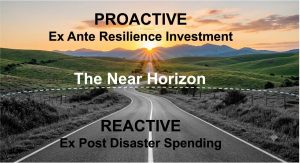
Wayne Gretzky once said, “I skate to where the puck is going to be, not where it has been.”
In adaptation and resilience (A&R) investment, The Great One is right, though Gretzky might have added: “…in the next three to five years.”
The hard-won secret to A&R investment is finding the “Near Horizon”: where resilience technology and solutions are investible now.
Three observations, and three recommendations.
-
Unavoidable, Sizeable…and Unevenly Distributed
GIC and Bain call A&R an “inevitable investment opportunity” and agree with Temasek, BCG, and McKinsey that it will grow to trillions of dollars across sectors by 2030. The demand is not in question.
The question is which A&R technologies will see increasing demand that investors can capture within the relevant investment period.
It is not if. It is where and when.
As William Gibson wrote, “The future is already here – it’s just not evenly distributed.”
-
Find the “Near Horizon”
The key to A&R investment is finding the sectors in the “Near Horizon,” where a sector has shifted from reactive, ex post disaster recovery spending to proactive, ex ante affirmative adoption of A&R technology and solutions. That shift drives growth beyond business as usual. It is the moment when climate risk and impact begin to generate extranormal demand. Regardless of who is in office, what interest rates are doing, or where tariffs land.
US electric utilities have shifted from reactive wildfire recovery spending to proactive investment in wildfire prevention. Southern California Edison went from spending $582M in 2018 to $6.2B from 2026-2028. That is not reactive spending on damage. That is proactive capital deployment into resilience solutions.
US water utilities present a different picture. Digital technology adoption grew only 5.5 to 7.5 percent from 2019 to 2024, and 60 percent of water utility managers report they would act on identified infrastructure investments only when something is about to break or fail.[1]
Electric utility resilience is where the puck is going. Water utility resilience may still be a bet on the come.
-
Pragmatic and Productive
Lightsmith identified more than 20 subsectors with technologies and solutions for A&R, totaling $170 billion in 2017 and growing to $480 billion by 2024: a roughly 20 percent compound annual growth rate. Investing across seven sectors over a decade, in supply chain analytics, risk analytics, precision agriculture, geospatial information, resilient food systems, water generation and efficiency, and health diagnostics, Lightsmith learned that the two highest conviction Near Horizon sectors globally are energy and infrastructure resilience and supply chain resilience.
Near Horizon investments generate measurable ROI. They create competitive advantage beyond loss avoidance, such as immediate cost savings, improved productivity, reliability and quality assurance. The goal is not getting back to the day before the disaster. It is going forward to better.
Three Recommendations for Investors
-
Duration, Duration, Duration
Near Horizon investments capture extranormal growth within the relevant investment period: three to five years for private markets. The discipline is matching observed, accelerating demand to the hold period.
-
Details, Details, Details
Think specific sectors in specific geographies in specific time frames. Eventually, everything everywhere will be affected by climate risk and impact. Just not all at once. Wildfire resilience in California today is followed by wildfire resilience in Europe tomorrow. Food supply chain resilience in Singapore, where imports are the priority, is different from food supply chain resilience in Brazil, where exports are the priority. The Near Horizon is local before it is global.
-
Review Lessons Learned
First-wave A&R deployment has produced hard-won lessons: where demand is real, where it is not, and where it is heading next. Seek teams who have already put capital to work in this space and can map where demand is heading next.
Gretzky seized the single-season goal-scoring record in 1981 and 1982 and won four Stanley Cups from 1984 to 1988.
Experience helps teach you where the puck will be.
Where do you see the Near Horizon?