
Lightsmith Group is attending London Climate Action Week this week. The surprising theme of the week is one we have focused on for nearly a decade: adaptation and resilience investment. Today I explain the urgent need to scale private investment in climate adaptation and resilience from a policy perspective. Tomorrow and the next day I will detail the investment case and key lessons learned from 10 years of focusing on adaptation and resilience investment.
Here are three reasons why adaptation investment is the defining climate policy imperative of 2026 and three concrete recommendations for what stakeholders can do about it.
Three Reasons Adaptation Investment is Urgent, Critical, and Pragmatic
1. It is Urgent and Unavoidable
Climate change risk and impact is no longer a future projection; it is a financial and humanitarian fact. Extreme weather caused over $260 billion in damages and more than 17,000 deaths in 2025 alone[1] [2]. The trajectory of global warming is essentially locked in over the next five to fifteen years, with some climate-driven changes now considered “unavoidable and/or irreversible” by the IPCC[3]. The World Meteorological Organization now projects that global warming is highly likely to exceed 1.5°C by 2030[4].
The demand for adaptation solutions is arguably more certain than the direction of interest rates, inflation, tariffs, geopolitics, or artificial intelligence. Singapore’s GIC calls adaptation and resilience the “inevitable investment opportunity.”
2. It is Critical to Climate Action
Adaptation investment addresses the immediate and increasing impact of climate change on the world’s most vulnerable and least responsible populations, particularly in developing countries. It is also essential to the success of mitigation investments: without adaptation, wildfires destroy electricity networks critical to the energy transition, and droughts undermine low-carbon agriculture and water systems.
Adaptation investment is a promise already made. The Paris Agreement ranks adaptation and mitigation equally, while the Global Goal on Adaptation calls for a tripling of adaptation finance[5].
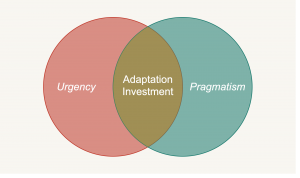
Adaptation investment is a promise that needs to be kept.
3. It is Pragmatic and Practical
Lightsmith’s CRAFT fund, the first private investment fund dedicated to adaptation and resilience, launched in 2019[6], and demonstrated that growth equity investment in A&R solutions generates commercial returns. The market has continued to mature: CIIP identified 65 commercially viable climate adaptation solutions in Asia in 2026[7], and 81 funders actively investing in the space across the region.
The broader investment community has taken notice. Temasek, GIC, BCG, Bain, and McKinsey concluded in 2025 that adaptation investment will be worth trillions of dollars by 2030[8] [9] [10]. Adaptation finance currently represents less than 4% of total climate finance[11], yet IFC has just reported that $1 of adaptation investment generates $8.60 in protected asset value[12].
Three Recommendations for Climate Policy Stakeholders
1. Build Coalitions of the Pragmatic
What climate action needs now is more than “coalitions of the willing.” What is needed now is “coalitions of the pragmatic”: public and private investors mutually committed to making concrete, regionally grounded, sector-specific investments with calculable financial returns and immediate, measurable benefits.
2. Deploy Blended Finance as a Booster Rocket
Blended finance has successfully supported the launch phase of first-generation adaptation investment vehicles such as CRAFT. The next challenge is to deploy adaptation investment at greater scale, beyond seeding new funds to scaling up platform strategies such as a FAST-P equivalent for adaptation that can attract capital that meets the scale of the challenge. Lessons learned from a decade of adaptation blended finance should now inform the next stage.
3. It is Pragmatic and Practical
For the first time, private investors have focused serious attention on adaptation and resilience. Capital, systems, and pipelines are starting to align. The window to partner with private investment is open, with high interest and real momentum. Private sector interest must be matched with public sector action.
Looking Ahead
Lightsmith was founded on the belief that adaptation is a significant and underserved investment opportunity that private capital can address. A decade later, that conviction has only deepened. Lightsmith looks forward to meeting that opportunity throughout London Climate Action Week and beyond.
Sources
[1] Aon. 2026 Climate and Catastrophe Insight. January 20, 2026.
[3] IPCC. AR6 Synthesis Report: Climate Change 2023. March 2023.
[4] Bloomberg. Global Warming Likely to Exceed 1.5C Through 2030, WMO Says. May 28, 2026.
[5] UNECE. UNFCCC COP30. November 2025.
[8] BCG. The Private Equity Opportunity in Adaptation and Resilience. May 6, 2025.
[9] GIC. Sizing the Inevitable Investment Opportunity: Climate Adaptation. May 2, 2025.
[11] Climate Policy Initiative. Global Landscape of Climate Finance 2025. June 23, 2025.